Monday, December 7, 2009

2nd land survey at Semakau - 4 Dec 09

I was back at Semakau over the weekend for a land survey and a hunting-seeking survey. Shall leave hunting-seeking to another post.

Similarly to our last trip, all the volunteers were split into 3 teams - the bird , insect and forest team. This time round, the bird team ventured out to a different location for this survey. We nearly aborted the mission because of the unexpected tall, thick and wet grassland, but still decided to stick to the area and were blessed with lots of exercising opportunties (my legs are aching!).


With great teamwork, we set up the nets. Because of the wetness, we tied the guy strings to the plants for support instead of using pegging the strings to the ground.


We were not expecting business on the first day, but were pleasantly surprised to find a Zitting Cistocola (Cisticola juncidis). Coincidentally, we also found 1 bird of this species on the first day of our previous trip. Before heading back to the visitor's centre to process the survey subject, we furled up all the nets and call it a day.


We set out at 6 am the next morning. After unfurling the nets, we adjourned to the rock bund before checking the nets 30 minutes later. Hoping that we will be as lucky as our previous trip, we did a round of chasing by spreading ourselves in 1 line while approaching the nets .

Try spotting the heads amongst the tall grassess!


Business was not good that morning though, we only found 2 subjects - a Zitting Cisticola (Cisticola juncidis) and a Black-headed Munia (Lonchura malacca).

During the 30 minutes interval, we had more than enough to complete the survey. First, we weigh the bird (by weighing the bird+bag first before weighing the bag alone). The Zitting Cisticola on the first day weighed only 6.5g!

Next, using the vernier calipers, we measure the length of the tarsus.


Followed by the the measurement of the upper mandible. I'm most fearful of this because there is that small possibility that I'll poke its eyes! The Zitting Cisticola must have felt the same, because it closed its eyes when I was measuring. Hopefully, practice will make perfect!


We also measure the length of its wings.


And the tail.


The length of its body will also be measured.


After the all the measurements are collected, we'll give the bird its passport to Singapore! The bird is ringed to allow future tracking.


Sometimes, the birds are also treated with a small dosage of syrup. I guess it must be an acquired taste, because the first Zitting Cisticola refused to take a single drop.


Presenting the 3 stars of the entire survey: here is the 6.5g Zitting Cisticola on the first day which I measured under many pairs of eyes. Immense stress.


Another Zitting Cisticola which I measured on the second day, this fellow was slightly heavier at 8g.


July's subject, the Black-head Munia who pecked a small hole out of the bird bag, either that or the hole was already there, and this smart kid managed to find the hole. Must have thought that it is an escape route.

All birds were then released after the neccesary data is recorded down.


We also saw many pretty flowers at the landfill cell where we conducted the bird survey, including this wild Orchid, which bloomed on the second morning.


The insects team had better luck and found a few interesting insects. I only managed to take a few photos, thanks to Dr Chua who took them out of the containers for a photo shoot.

Here is a very beautiful Common Tiger butterfly (Danaus genutia).


Here's another butterfly, not sure of its species though.


While business for the bird team was not so good this time round, trips to Semakau are always fun and interesting!

Sunday, December 6, 2009

First encounter with the Smooth Otters

I was laughed at for making a trip to Sungei Buloh on my annual leave day, but that's alright, because it was all worthwhile! Another impromtu decision, I brought my parents to Sungei Buloh on the morning of 25 Nov. It was an attempt to answer their questions on where I disappear to on weekends, and why I always come home with plenty of mossie bites.

They were initially complaining about mossies, and how I dragged them early in the morning to watch only 1 species of bird (Little Egret is all they can spot). This misconception was very quickly corrected through the bino which allowed them to spot many waders. The pretty Stork-billed Kingfisher (Halcyon capensis) we saw towards the end of our trip also helped to prove them wrong.


The highlight of the day has to be the Smooth Otters (Lutrogale perspicillata). We were at Platform 2, and I was actually looking for crocodiles when my mum asked 'what's that?'. On the opposite bank, one after another, the otters were running into the water, making loud calls. I almost went berserk! My mum initially thought they were seals..need to expose her more to nature and erm common sense.. =P

I counted, and I thought I saw 6 of them! Unfortunately, they swam so fast, I had no chance to take any photos of them, but I was happy enough to steal a few peeks at them!


I must say my mum really has sharp eyes. At the main bridge, she again spotted them, this time round swimming towards the main bridge. One by one, they came ashore to the box near the fresh water pond.

4 of them headed straight to the sand box and started rolling around, probably to maintain oil in their coat.


1 sniffed around the the water edge. Hmm..seems like they were only 5 of them. I probably have miscounted earlier on.


The playful group went to disturb the Malayan Water Monitor (Vararus salvator), which flinged its tail in protest.


The Otters seem to have the courtesy in taking turns to visit a nearby bush, not sure for what purpose, didn't quite look like it was their make-shift toilet. They look like they were in a 4x100m relay!


They hang around for about 10 minutes or so, and left for another swim.

I am convinced that its either a weekday thing, or I really need a companion's luck (in this case, my parents probably had beginner's luck!). I almost wanted to bet on '5566' that day, because in Aida's words, really 'huat' to see the Otters!! Can't wait for the next sighting! =)

Thursday, December 3, 2009

A day trip to the southern most tip of mainland Asia!

On 21 Nov 09, A group of us conquered the southern most top of mainland Asia at Tanjong Piai. It was a fun-filled day with random laughing fits over breathing, laughing 'styles' and delayed reactions. 

Tanjung Piai National Park covers 526 hectares of Mangroves and is the home to many species of mangrove plants and animals. As there are cultivated farmlands in the area, the mangroves have been conserved for the protection of the shoreline from erosions and storms.

Even before we reached the National Park, a Hawk Moth drew our attention and we crowd around it outside a toilet (!!), at a certain petrol kiosk.....


After 4 hours on the road (including 1 hour of stopover for yummy food) , we reached our destination.


Before embarking on the trail, there were already a few back mangrove plants in sight. The Mata Ayam (Ardisia elliptica) is one of them. This plant is named after its fruits because they look like and are about the size of the chicken's eyeball (ayam= chicken, mata = eyes) ! This plant can be recognised by its twigs which are swollen at the base.


It was lush greenery at Tanjong Piai - a mangrove forest with lots of healthy mature mangrove plants. A stark difference as compared to the mangroves we have in Singapore. Unfortunately, the place is also littered with lots of rubbish; its time they do some coastal clean up!


The Bakau Minyak (Rhizophora Apiculata) which has red stipules and elliptic leaves was most common at Tanjong Piai. They are easily identified because of their prop roots which increased their stability in the mangrove mud. This species is also able to exclude salt by a filtering system in their roots (by taking in the water, excluding the salt largely). The timber of the Bakau is also made into charcoal, a delight for bbq lovers.


Another common species is Bakau Putih (Bruguiera Cylindrica). Similarly, this species has their own unique way of coping with the harsh environment by having lateral roots growing just below the ground. Some portions stick out of the mud for better absorption of oxygen and looks like the bent knee of a human being.

One distinct feature of Bakau Putih is its sepals of the fruits, which curve backwards towards the fruit stalk.


See the pretty small flowers of Bakau Putih! They are pollinated by day-flying insects such as butterflies.


There is also another species of the Bruguiera spp at Tanjong Piai - Brugruiera Parviflora which ,unlike Bruguiera Cylindrica, have small yellow flowers.


Both Teruntum Merah (Lumnitzera littorea) and Teruntum Puith (Lumnitzera racemosa) can be found at Tanjong Piai, but I only managed to take a picture of Teruntum Puith (my first time seeing this!). A distinct difference between the two is the colour of their flowerse - red for the former, and white for the latter.

Heres a shot of the flowers of Teruntum Putih - pretty, aren't they?


With Christmas round the corner, Tanjong Piai has also started their celebrative atmosphere. A few shrubs of Sea Hollies (Acanthus spp) , named after the unrelated traditional English Christmas plant Holly, were looking really healthy and all "ready for Christmas". The edges of the leaves of this shrub are really sharp as compared to those we see in Sungei Buloh, largely because they are exposed to great amoung of sunlight at the spot they are located.


As the mangrove is home to many species of animals too, we had our fair share of encounters.  We saw quite a number of Blue-spotted Mudskippers (Boleophthalmus boddarti) on this trip. Though a fish, it has an amphibious behavior. It is able to stay on land as it retains water in its enlarged gill chambers to keep their gills moist while on land. It can also 'breathe' through its skin too. The 2 big bulging eyes works like periscopes of submarines, allowing it a 360 degree view above water.

The Blue-spotted Mudskipper, unlike other mudskippers which are predatory, grazes on the layer of algae growing on the mud.


These 2 mudskippers were chasing after each other, back and forth, as if in a courtship dance!


As we walk along the boardwalk, we also saw many Long-tailed Macaques (Macaca fascicularis) foraging the mangroves for food. Saw a few of them pounding hard at the mud and digging holes for food, looking hard for crabs, perhaps? This sneaky one climbed up a tree and was eyeing food....


left at the top of an tower, belonging to this group below. These man were stamping the ground, hissing and shouting at the monkeys to chase them away.  Is this a case of the monkeys disturbing the human beings? Or really, the other way round instead?


It was a sunny and humid day, probably for the monkeys too. This one was quenching its thirst by drinking human drink - some leftover of Peelfresh orange juice! The carton looked fairly clean and 'new', seems like someone had just littered.... =( With humans feeding them (yes, even if its unintentional), these monkeys might lose their natural ability to search for food (such as crabs etc) meant for them.


The mudcreepers, or more fondly known as chut chut can be commonly seen attached to trunks and roots of mangrove trees. The ones here looked bigger and fatter than the ones some may see in market - yes, they are sold live, and can be fried and eaten with chilli.


Hazel's sharp eyes spotted a baby Malayan Water Monitor Lizard (Veranus Salvator) hanging tightly to a trunk of a mangrove tree.


We also saw countless Mangrove skinks (Emoia atrocostata) there. As they are hardly seen in Singapore, we were all so excited when someone spotted the first one, and spent the longest time waiting for a good photo moment. It was until later into the walk that we realised that they are commonly seen, especially at sunny spots because these cold-blooded creatures relys on the sun to give them body heat.


On a Sea Hibiscus (Talipariti tiliaceum), 2 Cotton Stainer Bugs (Dysdercus decussatus) were mating away, fairly oblivious to our phototaking. They remained and walked around in the same position when they "felt embarrassed" in our presence.


And because of the above act, there are little small red Cotton Stainer Bug nymphs! Many of them were found in the seeds of the Sea Hibiscus, food for the larvae of the bugs. The nymphs' head is black in colour when young, as compared to the red ones of adults.


Looking really similar to the Cotton Stainer Bug, the Thespesia Fire Bug (Dysdercus simon) has a black- coloured head, instead of a red one. This is one endangered bug, and more commonly found on the Portia tree, whose seeds the  Thespesia Fire Bug's larvae feeds on. We were initially surprised to find this bug on the Sea Hibiscus, but later realised that it must be because there is a Portia tree beside it.


Dinner was at Kukup. While its not my first time here, the town was not really how I remembered it to be from my recollection, but the food was still as yummy as before.


Before we embark on our journey home, we were all elated to find a new species (of food) - Ang Ku Agar Agar Kuei - after our dinner at Kukup, and bought a few boxes home each! =P


Eveyone must be exhausted after a day of fun as it was all silence on the trip back. So yes - Congratulations! We have been to the southern most tip of mainland Asia!


Tuesday, November 17, 2009

Semakau Surveys - Retraining on 15 Nov 09

For the second consecutive day, I was back at Pulau Semakau, this time round for the (re)training of seagrass and line intersect transect. It was really reassuring to know that we have not been doing the wrong things for the past 1 year! I quickly told Hazel the good news today, because we were worried that the seagrass data trends Ron presented last Friday, was partially because our skills improved only towards the last few seagrass transects! Hee hee..

I've never blogged about the Creeper Snails (Cerithium spp.) before, in fact I rarely introduce them to visitors. These poor forgotten snails are the living vacuum cleaners of our shores, sweeping the mud for detritus as food. They are abundant along sandy and slightly muddy shores because they never run out of food! How lucky!


The seeds from the mangrove plant germinates while its on the tree, unlike the seeds of other plants. It forms a propagule and drops in the water once it matures and is ready to lead an independent life away from its parent. Initially, the elongated propagule floats horizontally but over time, it floats vertically after the roots gains weight from the absorbtion of water. Eventually, it takes root after locating a comfortable and suitable environment, just like the propagule in this photo.


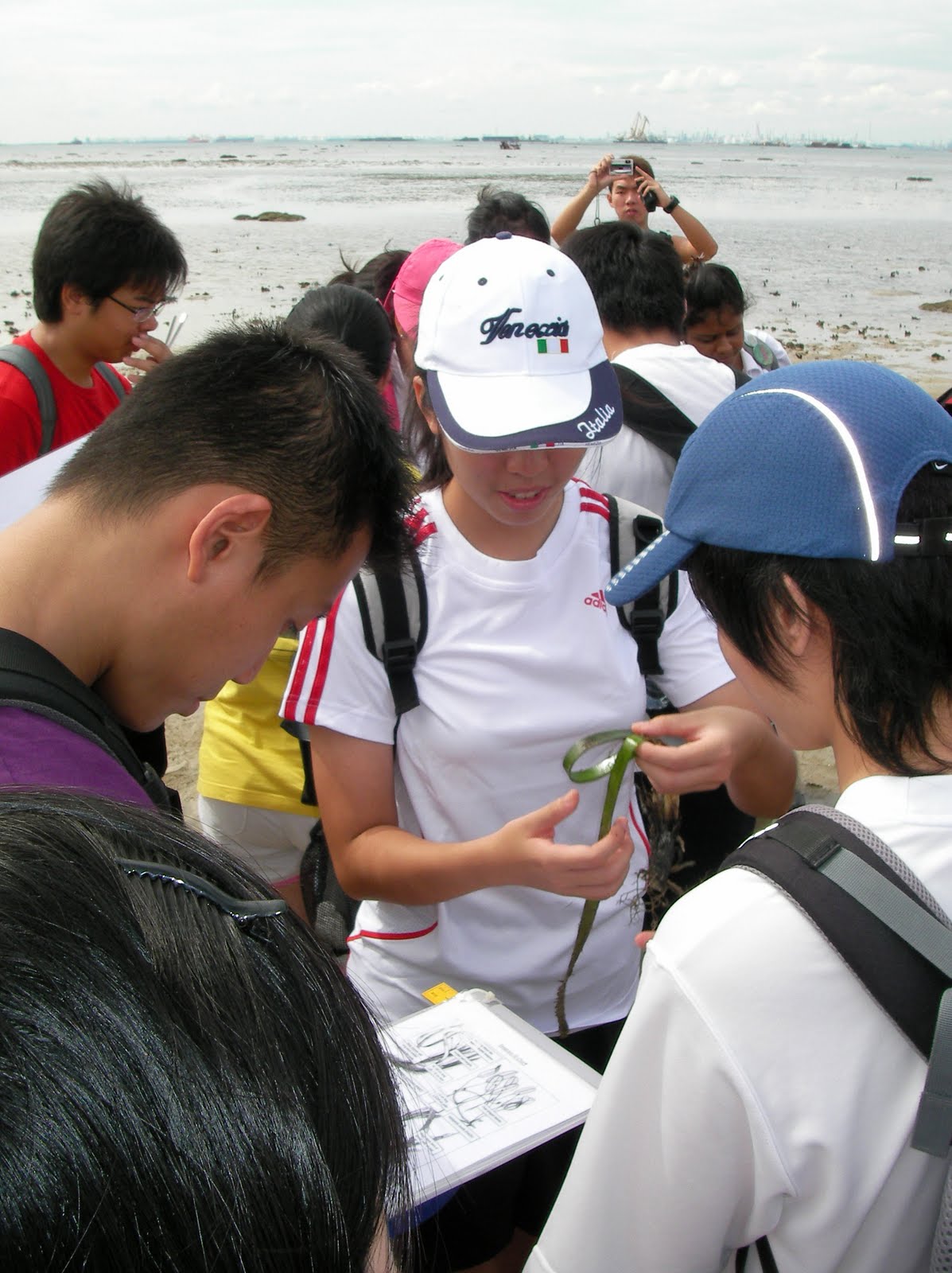
We were separated into 2 big groups, and I was to start with the Seagrass team first. Before the training commences, the 'older' volunteers embarked on the mission to find all 6 species of seagrass. Heres five of them, namely, 1) Enhalus acoroides , 2) Cymodocea serrulata, 3)Thalassia hemprichii, 4) Halodule uninervis and 5)Syringodium isoetifolium, laid neatly on the ground.


The 6th species is too small to be seen from the photo, heres a closeup shot of Halophila Ovalis - the Spoon Seagrass, which I have never recorded in all my past transects....heh heh.. hopefully its because it doesnt grow at our transect area!


The training first started with the challenging task of identifying the different species of seagrass. Patiently, we went through species by species to recognise how each of them looks like. The key differences between the species were also highlighted.


Here is a group comparing the actual sea grass vs the photo on the ID chart. Honestly, I must say this is really effective training. 1 year ago, we didnt have the luxury of a trial hands-on training. Identification of the sea grasses gave us much grief initially because we could not visualise how each species look like and thus had much difficulty looking out for them in subsequent transects.


Next was a step-by-step guide on how to conduct the transect - laying the measuring tape from left (shore on our left) to right, placing the quadrat at the right mark, identifying the species and its % cover , epiphyte cover, canopy height, algae species and % cover, fruits & flowers.


The group then dispersed into smaller teams of two/ three for an on-the-job training.

As we wade through the lagoon, we noticed that the water is speckled with many tiny white male flowers of the tape seagrass. A really good sign! The 'older' volunteers were also fed the seeds of the tape seagrass which taste almost like chestnut - thankfully I'm still sitting here, typing away... =)


After an hour, it was time to switch to the 2nd part of training - Line Intersect Transect. As we walked towards LK, we tread past the Sandsifting Sea Star / Common Sea Star (Archaster typicus) lagoon. Heres a four-armed seastar! One of the volunteers thought this seastar had lost an arm - although seastars are more commonly seen with 5 arms, there are those with 4 arms or > 5 arms as well.


Marks left behind by the Common Sea Stars - 凡走过必留下衡迹 applies not only to human beings!


After a round of explanation by LK on how to differentiate the LIT codes, the IDs and how to fill up the form, we spread out to start our trial LIT transect. I forgot to take any photos of LK's training because I was listening intently - I've never done a single LIT transect in the past year! Which is also why, ironically, I find the seagrass transect so much easier.


Zoanthids that were in our path during the LIT. Zoanthids are colonial anemones and have small polyps linked to each other. During high tide, their tentacles are extended to catch preys. I remember during one of the hunting seeking survey which Hazel and I were assigned to survey corals and sponges, we thought Zoantids were corals, and Ascidians were algae! *slaps forehead*


In one of the tidal pools, we saw 2 Sunflower Mushroom Coral (Heliofungia sp.). Often mistaken as a Sea Anemore or a soft coral, the Sunflower Mushroom Coral is actually a hard coral which you can tell from its hard skeleton in the middle. Unlike other hard corals, the Sunflower Mushroom Coral is a single living animal that is free-moving. They come in brown or green colours due to the presence of zooxanthallae. While it does not look like a mushroom now, it comes with a stalk and is stuck to a substrate when it is younger, looking just like a mushroom!


After 2 LIT trial transects, we had about 30mins to do a miniature hunting seeking survey. Our group must be quite lucky to see a few Worm-Eels (Muraenichthys sp.) as they are usually active at night. In addition, I had more than enough time to snap many shots of it. Typically, sightings of it are usually brief as they disappear rather quickly into some holes. Without scales and pectoral fins, they really look like a worm or sea snake with its long tubular body and the way it swims.


A regular sighting at Semakau, this trip was no exception. The Hairy Crab (Pilumnis vespertilio) was still very well-camouflaged and took my teammates some time to spot it.


My first sighting of a Hammer Oyster (Malleus sp), and I went on to see 2 more after LK pointed this one out to me. Unfortunately, the photo I took was not clear enough to depict the essence of its name (no prizes on how it got its name). The two-part shell is thick and T-shaped, looking just like a hammer.


We also saw a few Black-lipped conches (Strombus urceus). Similar to its Spider Conch cousin, the Black-lipped conch also has a strong mascular operculum that helps it pole vault around. I learnt that this conch is on our red list of threatened animal - probably due to the lost of habitat and over collection of its shells.


As I was taking the photo of the Black-lipped conch, Weihan called out to me and shouted 'Stonefish' - gave me a shock! The words 'Sea Cucumber' came 5 seconds later after he realised what he had said. Yup, this is a Stonefish Sea Cucumber (Actinopyga lecanora), looking just like a loaf of bread to me, although many will compare it to a smooth stone - how it looks like when it bloats up into a rounded, smooth shape, apparently when disturbed.


Look at its tube feet sparsely spread out on its body!


We also saw a really big Flatworm (Acanthozoon sp.) about 10cm long! This is the animal that I blanked out when I guided the day before..keke.. Flatworms are really flat and thin and can move into any small crevices. Oxygen diffuses through its body, thus it does not have a respiratory or circulation system. Many flatworms are carnivores and prey on tiny animals by injecting digestive juices into the prey. It then sucked up the liquefied meal.

Marine flatworms are hermaphrodites, that is, each flatworm has both the male and female reproductive organs. Just like human beings, they must find carrying a baby extremely tiring and laborious. Thus some species of flatworm tries to impregnate the other and results in 'penis-fencing' when the two flatworms meet. Amazingly, some species can impregnant each other simply by insert their penis in any part of the body!


Soon, tide was rising and water was becoming murky. We quickly walked towards the shore and along the way, I peeped into the rock where I saw the 2 octopuses the day before. Guess what, one of them was still there (looks like the same one to me)! I bet it had moved during the 24 hrs but being the smartest invertebrate, it recognised its track back to the same hiding place. Its other partner was nowhere to be seen though.


My last sight before leaving the intertidal area was this Fan worm. The head of this segmented worm has feather-like arms, and look just like a mini feather duster. These arms filters the water for plankton or detritus. They live in a flexible tube that is made of sand, their own saliva and mucus (reusing its existing materials, how very environmental-friendly!) which they hide into ,the minute they sense danger. The tubes also keep them moist and safe on occasions when they are exposed at low tide


Although it was a revision of the survey techniques, there were still many new things learnt. Also glad that I had a few first sightings (thankfully don't have to pay the person who pointed out these animals to me, unlike the first sighting of birds, else I'll be totally broke very soon).