Showing posts with label Semakau. Show all posts

Saturday, May 29, 2010

Murder of our marine life at Pulau Semakau

It was a depressing end to a Pulau Semakau trip that I had looked forward to. Witnessing the aftermath of a murder of our marine life was not what I intended to experience.

Not sure if this group was the culprit, but they appeared to be fishing with rods in their hands, in the vicinity of the island....


This huge drift net was the tool used for the act, and I bet these murderers didnt care that possesion of nets as a fishing gear is illegal in Singapore under the Fisheries Act.


A key criticism of the use of drift nets was its consequence of unsustainable fishing. In addition, this technique also caused excessive necessary harm to unintended targets such as marine mammals.

This morning, intentional or unintentional, the driftnet placed by the irresponsible caused the precious lives of 3 Blacktip Reef Sharks (Carcharhinus melanopterus).

Ironically, I had always wanted to sight these sharks previously. On many occasions, I had failed to see them despite my friends' attempts to point out the predators of the ecosystem swimming in the Phase 2 landfill cells. Today, my wish was granted in a brutal way.


This first shark that was caught in the net was about 1.5m long, had fairly fresh wounds on its body and probably died not too long ago.


The 2 other dead sharks were of smaller sizes, probably 0.5m - 0.7m long. I imagine them to be a family swimming together, unaware of the lurking danger. Perhaps they swam too quickly, failed to notice the net and ended up entangled.


It was really painful to examine the scars on the carcass caused by the driftnet.  


With the help of many, the drift net was cut and dispose of to prevent future repeated use. Regardless, this is a short term solution that will not stop history from repeating itself again. We destroy one, the irresponsible replenishes with a new one, and the crime begins again.


10 out of 10 of my friends were sure that sharks do not exist in our waters. If such irresponsible and unregulated fishing continues, this myth will become a reality. It is amazing that there is a lack of ownership of the issue, probably because this falls into a supposed grey area that doesnt come under anyone's purview.

While I often speak about the purpose of Project Semakau to many, this morning was a stark reminder of how real the urgency and importance of the project is.

The longer the status of our precious shore at Pulau Semakau remains status quo and not elevated to that of a marine park, the higher the risk we run of losing our rich biodiversity. This loss, is a nightmare I wish none of us will have to witness.

Sunday, April 4, 2010

Guided walk at Semakau on a stormy afternoon

We were back at Pulau Semakau on 4 Apr, for a guided walk with the students from Tampines Sec. Upon reaching the island, the looming dark skies spells of bad weather.


The perfect timing saw us seeking shelter at the entrance of the secondary forest - just as we reached the entrance point after the walk from the Visitors' Centre, the rain started pouring! Our hunter-seekers were already ahead of us, and I wondered if they too were seeking shelter in the forests.

After almost an hour, the rain though subside, continues to fall. The students, however, were not daunted a single bit and were really eager to start the walk.


With the absence of thunder and lightning, we braved the rain with our ponchos, for an hour of marine adventure.


Unfortunately, the first sight that greeted us was a drift net placed by irresponsible people. It had caught several fishes that were already dead. Drift net fishing not only results in unsustanable fishing, it also causes unnecessary harm to other marine animals that fishermen do not intend to catch. I shared the intention of Project Semakau with the participants, who concurred with the idea of gazetting the shore of Pulau Semakau as a protected area.


We visited the resident Anemone by the edge of the seagrass lagoon. Unfortunately, we didnt see the Anemone shrimp taking shelter under its usual host. The Anemone may look harmless, its lashing tentacles have stinging cells that may cause pain and discomfort to the skin.


Trotting on, I was glad to see the usual suspects at the sandy shore. The Sand-sifting Sea Star (Archaster typicus) is a good burrower of the sand (thus its name) and has a water vascular system to bring nutrients and oxygen through its body, unlike the blood circulation system in human beings. 


My heart almost sank when I saw the Hairy Crab (Pilumnus vespertilio) at one of the stations. The hunter-seekers had prewarned us that the showcase of a Hairy Crab at a station indicates the desperation of the unsung hero(ine)s. We couldnt ask for more, because animals were pretty much hiding after the downpour.

Named after its hairy appearance, this crab is slow in movement as compared to other crabs. To make up for the speed, its appearance allows it to camouflage really well both in water and on land.


Kudos to some keen eyes, the less common Heart Cockle (Corculum cardissa) was spotted! A bivalve, the Heart Cockle's 2 valves are separated by an opening that cuts through the middle. A victim to over-collection of its shell, it is often marketed as a token of love sometimes at a fairly cheap price, thus popular among couples.


A Ovum Cowrie (Cypraea ovum) was also seen moving along the surface. Another victim of over-collection, its shell was once used as a form of currency in the past. I wondered how that money system worked though, nonetheless glad its no longer the case else this snail would be extinct by now! The cowrie maintained its smooth and pretty shell by covering it with its own mantle, which protects the shell from any abrasion and scratches.


Not sure what the common name is, but the very uninnovative me calls it the Green Nudibranch (Ceratosoma sinuatum). Nudibranchs are named after the naked gills exposed at its back, which it uses to breathe. Interestingly, they are actually hermaphrodites, possessing both the male and female reproduction organs.


I was really happy to see the Cushion Star (Culcita novaeguineae) that is no longer as juvenile as a few months back. In its teenage months, this individual has clearly become rounder. This shape, coupled with a calcified body, makes it difficult for predator to prey on it. Hope that it will soon grow into a healthy adult!


Thanks to the hunter-seekers who braved the storm to find us a Knobbly Sea Star (Protoreaster nodosus), often the highlight of any guided walk. This species of Sea Star, named after the knobs on its body, is endangered on our shores and has fallen victim to the aquarium trade. I once saw one in a store at Plaza Sing, clearly looking undernourished. Human beings is one 'predator' that the calcified Knobbly cannot run away from.


The Fan Worm (Sabellastarte indica) was one of the few who gamely displayed its beauty on this rainy morning. Its feathery tentacles opened broadly, looking just like a fan and was probably lashing through the water for very tiny food particles. The tentacles is often the only part of the fan worm that is exposed as it lives in a self-made tube of its own mucus, sand and particles. Any detection of danger results in the tentacles retracting into the tube at lightning speed, which often wowed the participants.


Despite the bad weather, we still managed to experience the life of our shores. The participants' spirits were not dampened, instead are more willed to visit our shores again for more exciting encounters.

Sunday, March 21, 2010

Guided Walk at Semakau - March 2010

A group of students from Nan Hua high school joined me on a morning of adventure at Pulau Semakau. They were the Green Reps/ Ambassadors of their school, and I hope they will take home the message of conservation, and the 3Rs (Reuse, Reduce, Recycle) for sharing with their friends.


Once again, we were all intrigued by the rich marine life on our shores - something that many of us do not expect.

Apart from this Dragonfish Sea Cucumber (Stichopus horrens) that the hunter-seekers found, our group also saw 2 others as we waddled through the 'deathzone' of the seagrass lagoon. This species of Sea Cucumber is said to melt and disintegrate when exposed in the sun for too long. It can also shed its skin when stressed, so be sure not to disturb it unnecessarily.


Often thought to be a worm by first-time visitors to our shores, the Synaptid Sea Cucumber (Family Synaptidae) was a great show-and-tell partner. As I  was introducing it to the crowd, it gamely showed us how it lashes its beautiful tentacles to feed on detritus in the water.


The participants treaded carefully for fear of stepping on a 'land mine' - the Sandsifting Sea Stars (Archaster typicus)  were half buried in the sand. Camouflaging fairly well into the surroundings, we might just step on one if we don't watch our step. While they do not have a brain, and might not feel any pain, we can never be sure, can we?


I must apologise for the photo that doesnt do the Knobbly Sea Star (Protoreaster nodosus) any justice. Apart from being the icon for Project Semakau, our Knobblies often awed our visitors with its vibrant colours, pretty knobs (that gave its common name) and its sheer size (it can grow up to 30cm wide!). This Sea Star has a calcified body which makes it difficult for predators to prey on it.


Although mildly venomous, be sure not to touch the Black Long-spined Sea Urchin (Diadema setosum) as the spines can give painful stings if stepped on. The brittle and needle-like spines makes it challenging to extract it from our flesh too. In addition to being a defense mechanism, the spines , in partnership with the Sea Urchin's tube feet, helps it to walk.


My first time seeing a Juvenile Noble Volute (Cymbiola nobilis) whose shell is of a much darker shade. We were really lucky to see a pretty adult too. Unfortunately, this snail's existance is threatened due to habitat loss and over-collection of its beautiful shell - I have seen ,on several occasions, bazaar stalls selling spoons made from the volute's shell!


The Spider Conch (Lambis Lambis) may look unattractive at first glance, but I never fail to hear the visitors' 'Wahhhhh' when I turn it over to show its underside. Named after the spikes on the shell's edge that resembles the legs of a spider, the Spider Conch has a strong operculum and foot that allows it to pole-vault away on the surface.


Our adorable Polka-dot Nudibranch (Jorunna funebris) made a guest appearance too. Named after its exposed naked gills (the feather like structures), Nudibranchs are sea slugs and actually have shells when they are young, but sheds their shell thereafter. They thus develop other defense mechanism such as having warning predators that they are distasteful or poisonous with their bright colours.


Its my first encounter with this Nudibranch (and I believe its a first record for Semakau!). Not quite sure what species this is, but it certainly is huge, almost as long as the length of my 26cm chopstick!


Nearby, we also saw these egg ribbons, not sure if it was the eggs of the Nudibranch, but certainly a good sign that our shores are thriving with life!


It was Bull's eye for the group on their guess of how the Flatworm got its name - 'cause they are really flat! Pseudoceros sp.  was the only species we saw that day and the participants were surprised to hear that the flatworm is a Hermaphrodite which possesses both the male and female reproduction organs. Unlike us, flatworms have no circulatory and respiratory organs,instead oxygen and nutrients pass through their bodies by diffusion.


I had to remind the participants to be extra careful as we wade through the water near the reefs after noticing a few Sea Nettle Jellyfishes (Chrysaora sp.) pulsating near us - contact with their tentacles can result in quite painful stings! Jellyfishes also do not have specialized  respiratory, or circulatory systems as their skin is thin enough for the body to be oxygenated by diffusion.


Another Jellyfish we saw was this Upside-down Jellyfish (Cassiopea sp.) which gives a milder sting that can cause skin irritation with an exceptional itch. No prizes though, for correct guesses on how it got its common name. This Jellyfish harbours a mutually beneficial relationship with zooanthellae (single-celled photosynthetic algae) that is housed in its body. The algae shares its food with the jellyfish who in turns provides a home and minerals for the algae.


Occasionally mistaken for the Upside-down Jellyfish, the Hell's Fire Anemone (Actinodendron sp.) is one you don't want to mess with. Aptly described by one volunteer, the sting from this Anemone burns you like how a fire will, and hurts like 'hell'. Although I have no personal experience to speak of, I sure don't want a taste of that feeling. One can identify the Anemone by its radiating white stripes from its centre disk, and its branching triangular-shaped tentacles.


We were really lucky to see this Heart Cockle (Corculum cardissa), not as commonly seen due to overcollection of its shell. A simple googling will show you how its being marketed as a token of love, sold a fairly cheap price. Little do couples noticed that this clam's opening of the valves cuts vertically across the centre of the 'heart', just like how we often depict a broken heart. In my opinion, a bad omen and not a good token of love at all!
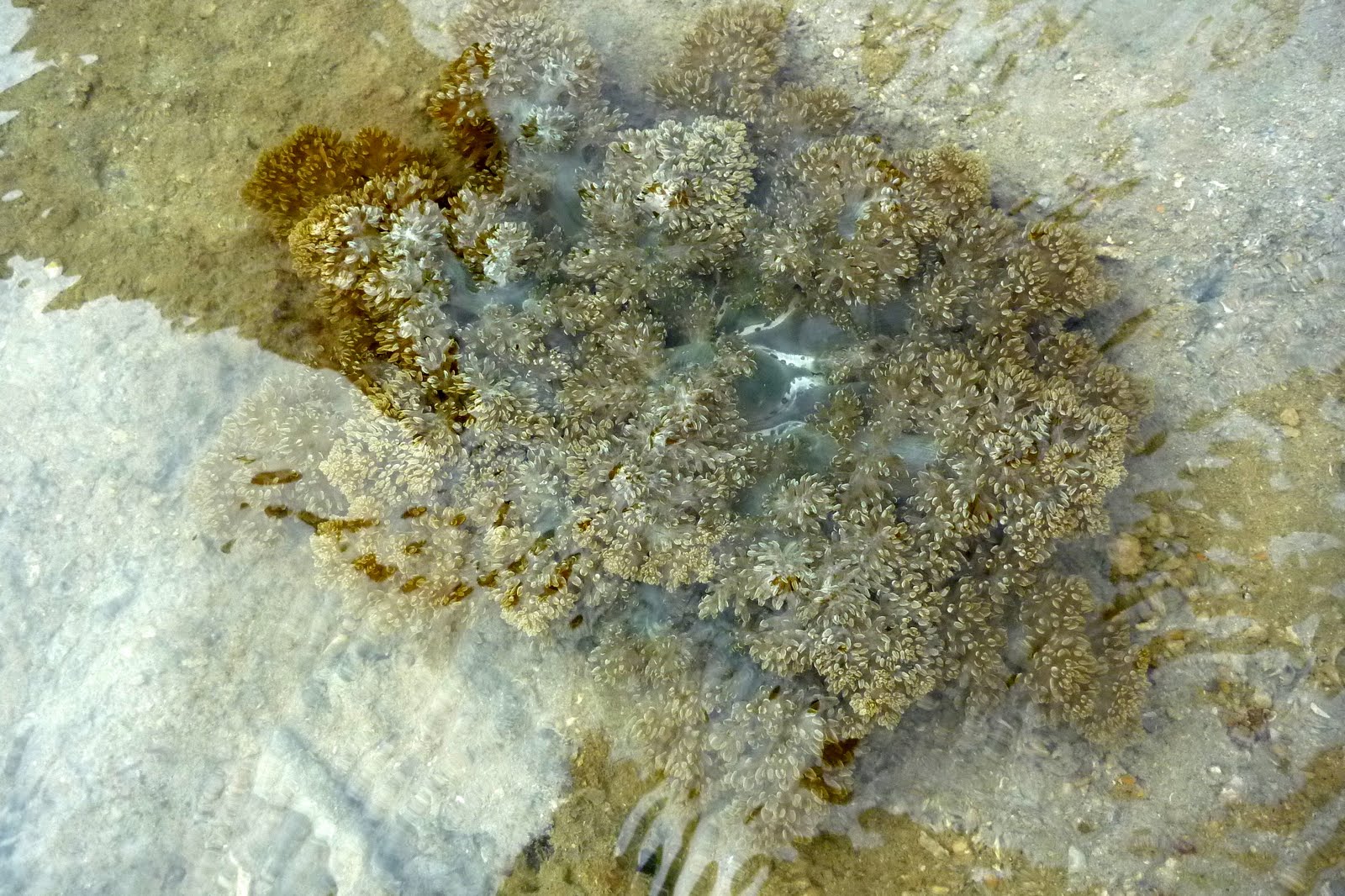

Per usual trips, we had a chance to visit our resident Fluted Giant Claim (Tridacna squamosa), but for as long as we keep the environment protected, clean and for its growth. Unlike most other bivalves, the giant clam harbours single-celled algae ,in its fleshy body, which produces food through photosynthesis. To maximise its "farm", the clam exposes these algae to the sunlight by facing the mantle to sunlight, at the same time, giving us a wide smile!


Yet another fruitful trip to round up my intertidal walks in March. =)

Wednesday, March 3, 2010

I never seem to get enough of Semakau!

After a month of hiatus, I was back at Pulau Semakau last weekend for Seagrass transect on Saturday, and guiding on Sunday. We were blessed with good weather (albeit scorching hot though..sigh..El Nino effect has resulted in Singapore's driest Feb in 140 yrs!), and I was really glad to have a fantastic group of participants from ITE Green Club who were really keen and interested in nature. Icing of the cake was having an outstanding guide as my partner.

The inspiration of Spongebob Square Pants (or so I say), the Sea Sponge is often thought to be a plant. Not surprising because this animal looks very much like one, without the typical facial features and movement. Comprising of very few cells, this animal (is an animal because) feeds by pumping water in and out of itself, picking up detritus in the process. Interestingly, dried sea sponges are used at home by people in the past. Thankfully, the ones we use now are synthetic sponges, else we end up overcollecting again.


The Hairy Crab (Pilumnus vespertilio) played dead in our path. Strangely, this cute teddy was not camouflaging itself against a sponge or a rock per usual. The long hairs on its body and limbs trap sediments to help it blend into the surroundings. In water, it fluffs up which breaks its body outline, making it difficult for predators to spot its presence. Not the 大闸蟹 that participants are more familiar with, this hairy crab is in fact mildly poisonous due to its diet.


The shore was like a mini childcare centre with the hunter seekers' excellent finds of 3 juvenile Cushion Star (Culcita novaeguineae)! I have seen #3 on past trips (and it certainly has grown!), but not #1 and #2! Great news that our shores are alive and growing!

Junior #1

Junior #2

Junior #3

Grandparent Cushion Star was also sighted! This star certainly left all of us in awe with its sheer size. Participants were surprised that the Cushion Star can grow to such size (almost >20cm wide)! With thick calcified walls and a rounded shape, the Cushion Star is a tough nut for predators to bite on.


With Valentines' day just passing us by, the courtship celebration certainly has not ended for the Sandsifting Seastars (Archaster typicus). Many pairs were seen in their psuedo-copulation position, getting ready to release the sperms and eggs (without any contact of their reproductive organs) when the tide comes in.


Of course, how can we miss the iconic Knobbly Sea Star (Protoreaster nodosus)? The participants were thrilled to see the real thing after much anticipation from spotting a picture of it at the visitor centre. Named after the knobs on its body, this Sea Star also also has a calcified thick body that makes life more difficult for predators. Even with this natural art of defence, the Knobbly is still endangered due to the aquaruim trade and loss of habitat.


My fellow guide explained the over-collection of the Sandfish Sea Cucumber (Holothuria scabra) due to its popularity as a dish on our tables. Belonging to the same family as Sea Stars, these Sea Cucumbers circulates water through its body (vis-a-vis us our blood circulatory system) and thus we shouldnt remove them out of water unneccessarily to prevent stressing them out. While edible, they must be processed first as they are mildly poisonous.


Our second Sea Cucmber of the day was the Synaptid Sea Cucumber (Family Synaptidae). The longest species that can grow up to 3m long, this individual was gingerly lashing its feathery tentacles in the water to pick up detritus. Without tube feet, they hold on to the substrate with hooked spicules instead, similar to how velcro works. Its thin dedicate wall is certainly one good reason why we shouldnt handle them.


Smooth to the touch and looking just like a polished stone, the Stonefish Sea Cucumber (Actinopyga lecanora) is a better player at beauty care, a stark contrast to the Sandfish Sea Cucumber's rough skin that we encountered earlier in the walk.


Another beauty was the Moon Snail (Polinices sp.), looking ever pearly and white like the full moon. This fellow stealthily burrowed into the sand while we were introducing the Sandfish Sea Cucumber by its side. A fierce predator of other clams and snails, the Moon Snail uses its huge body to suffocate its prey. Failing which, it secretes an acid to create a hole in the prey's shell before inserting its radula to enjoy a hearty meal.


I can never get enough of this shore, because there is never an end to the animals to see (especially when my first sightings) ! My first encounter with the Bornella stellifer Nudibranch. A sea slug, Nudibranches are born with shells but sheds them as they grow older. For protection, they develop bad tasting glands to fend off potential predators, and are kind enough to warn others via its bright colours.


One of the more poisonous Nudibranchs, the Phyllidia varicosa is said to release a toxic substance into the water when stressed. Good reason not to keep any in your tank!


Great eyesight from another Guide who spotted the Ceratosoma sinuatum. Excited to see it as its my first sighting!


Although not my first sighting, I was still happy to meet the cute Polka Dot Nudibranch (Jorunna funebris). Nudibranch = Naked Gills in Latin, and refers to the exposed feathery structure on its back, as seen in photo below.


While many of us are familiar with Nemo, the pair of Anemone Shrimps (Periclimenes brevicarpalis)were new to my participants. These freeloaders are unaffected by the Anemone's stinging tentacles, all thanks to the layer of mucus that coats its body.


As we were waiting for our turn at one station, I spotted what looks like a juvenile Hell's Fire Anemone (Actinodendron sp.). As its name suggest, this is one animal you wouldnt want to touch else be prepared for really painful stings I don't even want to imagine. Often mistaken with the Upside-down Jellyfish, the Hell's fire Anemone has white stripes radiating from its centre, and has triangular-shaped tentacles. /edit oops! This is not a Hell's Fire Anemone! But a Branching Anemone. Thanks LK for the correction!


Here's a really cute baby Upside-down Jellyfish (Cassiopea sp). It was really a joy to observe it pulsating and turning itself upside down. This juvenile has the symbiotic algae to thank and rely on if it wants to grow into an adult, as the algae shares food with it in exchange of shelter.


The Fan Worm (Sabellastarte indica) displays its usual pretty featherlike tentacles that gave it its name. An envy of many, this segmented worm builds its home from recycled materials such as its own mucus, saliver and sand (therefore unaffected by scaling property prices!) . Indeed a green ambassador of Semakau, it showed us its agility to retract in lightning speed into its tube for hiding.


I almost mistook this Flatworm as Pseudobiceros uniarborensis. Nature has its own way of confusing me with its splendid colours. A search on the internet suggests that they could be from the same genera or families - or this could be due to evolution due to environmental factors, you think?

Our participants laughed when we started saying 'Flatworms are called Flatworms because they are really flat' - it is true! Due to its paper-like physique, they can tear easily and thus must never be handled. The same physique ,however, also allows it to hide into any crevices. Everyone was tickled by our short skit in mimicking how flatworms tries to poke each other in an attempt to impregnate the other since they have both the male and female reproductive organs.


We were thrilled to see both the male and female Tigertail Seahorses (Hippocampus comes) whom are named after the yellow and black alternating stripes on its tail. Although a fish, the Seahorse, do not have scales as fish do, and swims upright instead of horizontally, using their dorsal fin to propel and pectoral fins to steer direction.

Envy of all females, it is actually the male seahorse that carries the eggs in a brood pouch on their chest which apparently can hold thousands of eggs laid by the female seahorse!

Unfortunately, Seahorse populations have been endangered due to over fishing (largely due to its medicinal use in TCM) and habitat destruction.


Our smiley resident Fluted Giant Clam (Tridacna squamosa) was at its faithful spot. Among the largest bivalves in existance, the Giant Clam harbours symbiotic algae which shares the food it makes with the clam. This is also why we often see the clam 'flashing' its mantle so as to expose the algae to sunlight for purpose of photosynthesis.


I always enjoy introducing the Spider Conch (Lambis lambis) to participants as they never fail to respond with a 'wooooow' when they see the conch's beautiful underside vis-a-vis the algae covered outer shell. Named after its spider legs-like spikes on the outerlip, this champion pole vaulter uses its strong hooked-like operculum to hop around - a pity that we didnt get to witness it in action.


It was definitely a very enjoyable trip for me, thanks to my wonderful companions!