Saturday, March 20, 2010

Friendship is.....

... being a cushion (or a punch bag for that matter) for your friend, even though it means allowing him/ her to place his/her smelly foot on your belly....


... being really upfront with each other. Friends are transparent to each other, and if we have to lay the cards on the table, we fight it out once and for all.  


... nudging each other after the big fight. We quarrel, but we reconcile too. We forgive, and we forget.


... sometimes, seeing eye to eye. Working together towards a common vision, we are likely to have the same values, driven by the same passion. Friendship is often, one mind in two bodies.


... not seeing eye to eye in many matters. Strength lies in differences, not in similarities.


... not being afraid to give a constructive reminder kok on the head. Better he or she be told off by me, than by others.


... being a mirror image of the other if the kok doesnt work. Having a taste of one's own medicine is always cruel but experiential learning always seem to work better.


... watching each other's back. There is no 'I' in a 'Team'.


... looking beside you when it hurts to look back, and you're scared to look ahead, because you will always find your friend there...


... being a pillar of support no matter what happens. A real friend is one who walks in when the rest of the world walks out.


..... accepting each other's differences, even if the other is clad in dirty sand and mud all the time...


Are you a friend to another?


.
.
.
.


Go on, appreciate a friend today.. =)

4-hr date on 19 March with the Smooth Otters

I must have walked up and down the main bridge of SBWR more than 30 times on the morning of 19th March. That approximate 300m displacement from the main entrance is all I managed during the 4-hr trip, pretty much because of the stalking of our endearing Smooth Otters (Lutrogale perpicillata).

Quite perfect timing, the gang of 4 swam towards the main bridge just as we were crossing it. One of them showed off their multitasking skill by yawning and swimming at the same time. No wonder, it was barely 8am in the morning. I was yawning and walking at the same time too. =)


3 of them frolick around the area for a short while, catching fishes while waiting for a member who has lagged behind to catch up.

As they walked ashore, they disappeared behind the mangrove plants. So, why did the otter cross the road/ path?

Because they love to enjoy a hearty breakfast at the prawn pond! With the otters swimming back and forth, and round and round the prawn pond, the 3 of us (the human beings) walked up and down the path, following the direction in which they were swimming (the otters) towards.

While I have never been a big fan of fishes (as a food source), I must say the manner in which the otter feasts on really made the sashimi seemed really yummy. The crunchy sound, coupled with the the otter's enthusiasm and look of satisfaction, gave me second thoughts on whether I'm missing out on some gourmet food!

I was secretly pleased to note that I'm not the only lazy bum in the world! What's best after a full stomach? A nap! shiok only if you lie on your back, spread all paws out, and basically couldnt care less about the spinning world. I, need to learn (about taking it easy that is, not the sleeping posture).


Amazing how we can spent another 1hr+ at the freshwater pond, of course with lots of action from the otters, which I will leave to the next post. =P

In summary, they played hard, the rested, and they performed (or so I think).


Near noon, these otters were STILL at it! Talk about having enormous amount of energy! They must have gotten a little bored with each other, one started gnawing at the cat tail! Not sure it its for play, or for a good reason, but for sure, its something that I wouldnt imagine the authorities to be very pleased with.

Even as the afternoon crowd started to gather, these otters didnt seem bothered with the buzz! Hopefully they won't get so used to human beings that they let their guard down.


The sighting of the Estuarine Crocodule (Crocodylus porosus) must have been the happiest for, ahem, my pseudo daughter. Its her first time meeting these reptiles wild in our reserves! It was quite hilarious how she was still wondering why we were busy snapping photos away, not realising the crocodile's presence. I wouldnt blame her because the still crocodile looks just like a log in water, and part sometimes part of the mangrove plant (trunk) on land.


Being cold blooded, it is not uncommon to see them basking in the sun on a bright sunny morning. This act allows it to regulate its body temperature using the warmth from our natural source of energy.


While it is the largest of all living reptiles, the Estuarine Crocodile that can grow up to 8m in length is seen to be no longer than 3m in our reserves. Although ferocious, these crocodiles have plenty of fishes to feast on in the reserve, they do not pose as a danger to human beings, unless provoked and threatened, of course.

It was interesting to note how the crocodile changed its position when the tide was rising. It looked pretty much like a helpless soul, stranded on an island, soon to be drown! Can't quite happen, because they swim fairly well!


*HELP!*

We left the reserve for a good meal of Ramen, not sashimi at Holland Village, before continuing the day's adventure at Pasir Ris mangroves! Its been a long while since I last visited, but I realised I didnt take many photos! 

I havent seen the Black-crowned Night Heron (Nycticorax nycticorax) for a long while! We must be quite luckily, because this heron is primarily more active at twilight. A locally endangered species due to loss of nesting sites and chemical (pesticide) poisoning, it lives mainly in mangroves or near water bodies with plenty of fishes.


One of the highlights of the trip has to be my second encounter with a 'crocodile'!  It was my first meeting with Bruguiera hainesii, whose Malay name means 'crocodile's eyes'.


The bashing through of the forest was all worthwhile, for the cigar-like propagule, and pretty flowers!


Although the weather didnt hold up, and we were caught in a heavy downpour towards the end of the trip, it was still a really fun outing. Definitely a great way to spent my annual leave day!

Monday, March 15, 2010

Leisure walk at SBWR - 14 March

March was really a mad month at work with all the tight deadlines, and I ended up with lots of blog debts of all the weekend trips!

Together with a few friends, we spent an entire morning on 14 March at Sungei Buloh, and were pleasantly surprised with many unexpected sightings.

The replanted Berembang (Sonneratia caseolaris) at the entrance of the Reserve has always been in the limelight as this species is very rare in Singapore. This Serembang that has grown naturally is likely to take over the spot the next time we visit the reserve. The only Sonneratia with red stamens, it also has a flat calyx. Durian lovers have the Sonneratia to thank, because of its role as a food source to sustain bats who polinates the Durian trees. The Sonneratia is especially importatnt during the times when Durian tree is not flowering.


The Sea Hollies are named after the unrelated Christmas plant Holly because their leaves look fairly similar. However, not all species have spiny leaves though. The Acanthus volubilis usually does not have the sharp spiny leaves and is more of a climber.

Acanthus ebracteatus, on the other hand, has very spiny leaves. The Sea Hollies adapts to the environment of high salinity by secreting excess salt through the leaves.


Less common in the reserve is the Acanthus ilicifolius with the light violet flowers.


Another great discovery is that of a fruiting Finlaysonia Ovobata along the mangrove boardwalk. Needless to say, we spent a good 15-20 mins taking many shots of the fruits.

\
Living in harmony were 3 species of birds, perching on a barren tree. We have the Asian Glossy Starling (Aplonis panayensis), the Pink-necked Green Pigeon (Treron vernans) and probably Olive-backed Sunbird (Nectarinia jugularis) 排排站ing on the branches.


True to its name, the Yellow-Barred Flutterer (Rhyothemis phyllis) was fluttering over our heads really quickly, as if playing the game of catching with our cameras. It was really exasperating trying to take a sharp photo of it.


Safety in numbers, the Shield Bugs (Calliphara nobilis) gathered behind the mangrove leaves possibly for shelter. Their shiny wings make them look just like gems, albeit hidden, in the mangroves. They apparently disperses with a loud buzz when disturbed, so be sure not to do disturb them if you don't want to be startled!


After so many trips to the reserve, its only my first time meeting the Yellow-spotted Mudskipper(Periophthalmus walailakae). I guess thats because I never really took a closer look because they are supposedly one of the larger and obvious mudskippers around. This Yellow-spotted Mudskipper can tolerate long durations out of water by trapping water and oxygen to help them breathe on land. Their ability to breathe through their moist skin helps too, which is why we often see them walking into small puddles (to keep skin damp).


As the tide rose, we saw this Blue-spotted Mudskipper (Boleophthalmus boddarti) who appeared to be hanging on to a mangrove root for dear life using its muscular pectoral fins (although it can actually swim!). Unlike other mudskippers who are predators, the Blue-spotted Mudskipper grazes on the layer of algae growing on the mud instead.


I was a little disturbed by this pack of fierce dogs who were barking and fighting in the reserve. I've seen stray dogs chase after otters and essentially, they become a threat to our wildlife in the reserve. Hopefully they will be displaced at another more appropriate environment soon!


My all-time favourite Smooth Otters (Lutrogale perspicillata) also made a stopover at their usual sandbox! This was a group of 3 and 2 of them were grooming each other - quite a sweet sight!


,,,while the third one made itself really comfortable, sleeping on its back, at the same time enjoying a bask in the sun.


Was it my eyes or did the otter just winked at us? =P


One of the common reptiles in the Reserve, the Malayan Water Monitor (Varanus salvator) was sun-tanning to regulate the temperature of its blood. It has an excellent sense of smell, owing to its forked tongue that it sticks in and out of its mouth. The bite of the monitor lizard is venomous so be sure to leave them alone and not provoke them if you cross their path.


My second time seeing the Green Crested Lizard (Bronchocela cristatella), the first being more than 1 year ago! This lizard's body can turn brown when threatened. The number of Green Crested Lizard is apparently on the decline in Singapore - some said possibly due to competition from the Changeable Lizard, an introduced species.


While the Lizard was fairly cooperative in posing for photos, it was still challenging to get a clear sharp shot with the poor lighting.

The amazing fact of such nature places is that there are always new surprises on every trip, no matter how many times you have been there. I guess this is also why many of us keep visiting these havens over and over again because each experience is never quite the same!

Tuesday, March 9, 2010

To the Magical Mangroves of Mandai

An entry from the Diary of Pobby the House Gnome.

8am, 7 March 2010 - Weather: Fine

Pobby's back is aching now from all the forward bending. Kept having to dig out Mistress (Jiamione)'s lousy booties from the ground as it was stuck in mud every other step.

Pobby followed mistress and her friends (maiden trip for most of them) to the magical grounds of Mandai this morning. At platform ten and one quarter, we met Prof Luanbledore and her nature-loving friends.
 

We missed the Mandai's express, and had to take a short walk to a special opening to enter the Mangroves.
 

Before our eyes stood some tall and mighty mangrove trees - many many times taller than Mistress. Pobby learnt that the mangrove habitat is a very harsh environment to live in. There is high salt content in the environment; the soil is soft and is low in oxygen content. Pobby definitely won't be able to survive in such an environment, unlike the mangrove plants who have special adaptations.

The mangroves are important because it is the home for many many marine animals, such as mud crabs, tiger prawns etc which Pobby loves to eat. Pobby is sad to hear that we have lost much of this habitat to urban development. Without their home, the marine animals will die, and Pobby will have not have crabs to eat. =(

Pobby has never experienced a tsunami, but was told that the mangroves act as a protective shield for coastal areas as they help to reduce the impact of the huge waves.

note: thats not Mistress - thats Mistress's friend, Rowdy from Nature school

Pobby learnt about three main groups of mangrove trees - Rhizophora spp., Bruguiera spp. and Avicennia spp. today. Incidentally, the names of the species sounded like the magic spells that Mistress practises everyday.

1) One species of Rhizophora spp. (a.k.a Bakau) is Rhizophora apiculata. This is one of the most common species found in the local ecosystem. They are easily identified by their prop roots that helps anchor the tree in the unstable mangrove mud. The roots not only helps the tree to breathe, but also has a filter that can exclude salt from the water it takes in.

Pobby likes Bakau because its timber makes excellent firewood and charcoal! (Pobby loves BBQ!). It is also an excellent source of wood as it is naturally straight, strong and is resistent to insects and salt water.


2a) Presenting *raises wand* Bruguiera Gymnorhiza of Bruguiera spp. - another main group of mangrove tress locally. These mangrove trees cope with the low oxygen content by having lateral roots that grow just below the surface of the mud. Some parts of the roots stick out of the mud and looks just like Pobby's knees! These exposed roots help to absorb oxygen better.


2b) Another species of the Bruguiera spp. is the *raise wand again* Bruguiera Cylindrica which has small white flowers which are pollinated by insects such as butterflies. Pobby thinks that the sepals of the fruit that curves backwards towards the fruit stalk looks just like an Octopus.


3) Avicennia spp. is another group of mangrove trees that Pobby saw today. Also known as Api-api, this group has an extensive root system that spans many metres below the mud surface, and sticks out of the mud vertically. These breathing roots looks like the pencils that Mistress uses in school. The leaves of the Api-api has salt glands to secrete salt. The salt crystals are then left behind on the leaves after evaporation. Pobby now knows where to look for free salt when it runs out in the kitchen!

Here is Avicennia Alba with leaves that are white and waxy on the underside to reduce water loss. Pobby really likes the small yellow pretty flowers of Avicennia Alba.


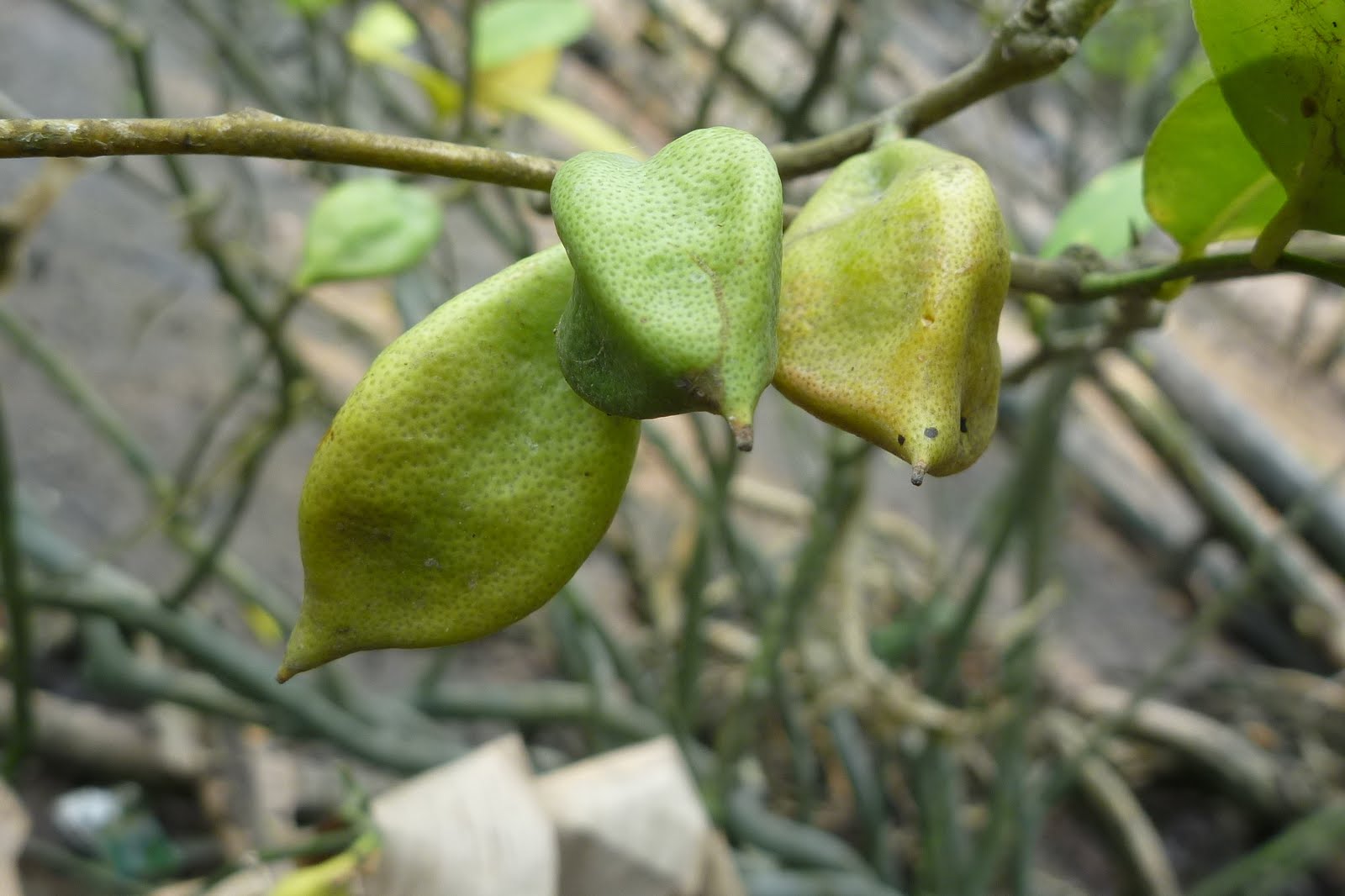
Prof Luanbledore and friends were very excited to find the Mangrove Lime (Merope angulata)! This is because the Mangrove Lime is a rather rare mangrove associate locally. Pobby is really lucky to be able to see it personally. The plant was fruiting too! Pobby was too scared to try the fruits which are said to be sour.


Appearing in the middle of the path, this Mangrove St Andrew's Spider (Argiope mangal) gave Pobby a scare. The female spider spins an orb web which contains 2 zig zag bands. The male spider,usually much smaller in size, can be found on the web but Pobby's eyes are not sharp enough to spot them.


Pobby also saw 2 Mangrove Horseshoe Crabs (Carcinoscorpius rotundicauda), who seem to be pairing up. Pobby is impressed with Horseshoe crabs because they have lived over 400 million years! Although called 'crabs', they are actually more related to scorpions and spiders. Pobby was told that one reason why they can survived for so long is due to their special blood which is blue in colour when oxygenated and has the ability to detect bacteria! The blood clots immediately when in contact with bacteria.

This horseshoe crab has lots of barnacles growing on its back - which reminds Pobby of the times when she has to carry sacks of rice on her back - must be heavy for the horseshoe crab?


Pobby was just complaining that everything on the ground looks dull with all that brown, and was most happy to see the Face-banded Crab (Perisesarma eumolpe). These crabs wears a bright band across its face, looking just like some tribal people.


Although it was a tiring trip for Pobby, Pobby still hopes to have a chance to return to Magical Mangroves of Mandai again (next time round, Pobby will remind Mistress to wear better booties). More importantly, may the magic powers help the mangroves overcome the development plans of he-who-must-not-be-named.